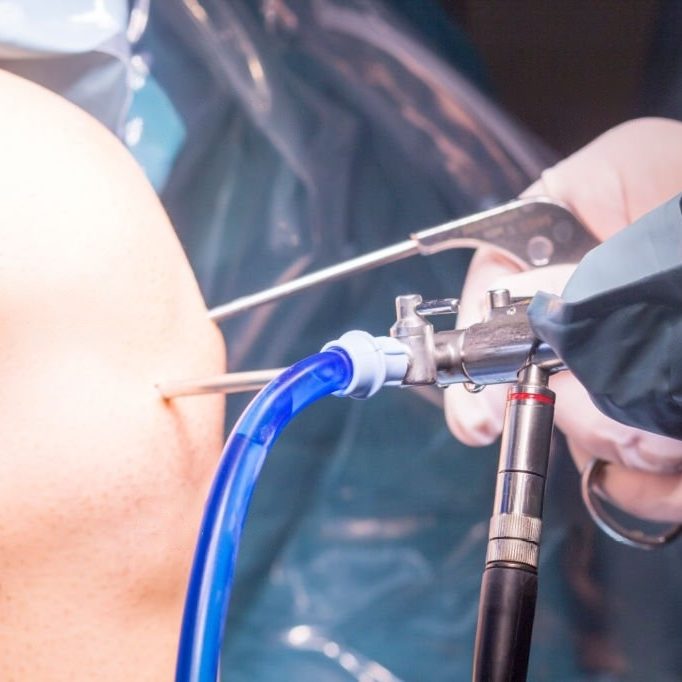
Immediate recovery and a return to sport are hugely important. Whether it's a meniscus tear, chondromalacia, a cartilage lesion or a ligament rupture, getting back to daily life, work, sport or school within 3 to 4 weeks is very valuable — let alone for a high-performance athlete. Arthroscopy makes exactly that possible.
What is arthroscopy?
It is a minimally invasive surgical technique: through very small incisions, a camera and the necessary instruments are introduced to diagnose and treat the inside of the joint, without having to open it fully. The result is less pain, less bleeding and a much faster recovery.
Knee: what we treat
Knee arthroscopy resolves, in a minimally invasive way:
- Meniscus tears (reshaping or repair).
- Chondromalacia and cartilage lesions.
- Ruptures of the cruciate ligaments (ACL reconstruction).
Knowing the preoperative protocols allows you to strengthen beforehand. Afterward, movement begins immediately during recovery, and weight-bearing starts at the right moment.
Start of weight-bearing: at 4 days when no cruciate ligament or meniscus was repaired; at 3 weeks when those structures were addressed.
Shoulder: what we treat
Shoulder surgery, though more complex, also has an excellent recovery. When needed, it offers clear benefits:
- Provides stability to an unstable shoulder with recurrent dislocations.
- Restores function of the main tendon of rotator cuff movement: the supraspinatus.
- Relieves the painful subacromial impingement syndrome.
The arthroscopic option is, by far, the least painful. If you have that possibility, have the surgery.
Impact level: when to move again
General guide to returning to exercise after surgery (always individualize it in consultation):
| Level | Description and examples | After surgery |
|---|---|---|
| Low impact | Stationary bike, swimming, elliptical. | 15–30 days |
| Medium impact | Walking, dancing, yoga. | 30–45 days |
| High impact | Running, jump rope, aerobics. | 3 months |
| Contact sport | Soccer, rugby, boxing, CrossFit. | 6 months |